

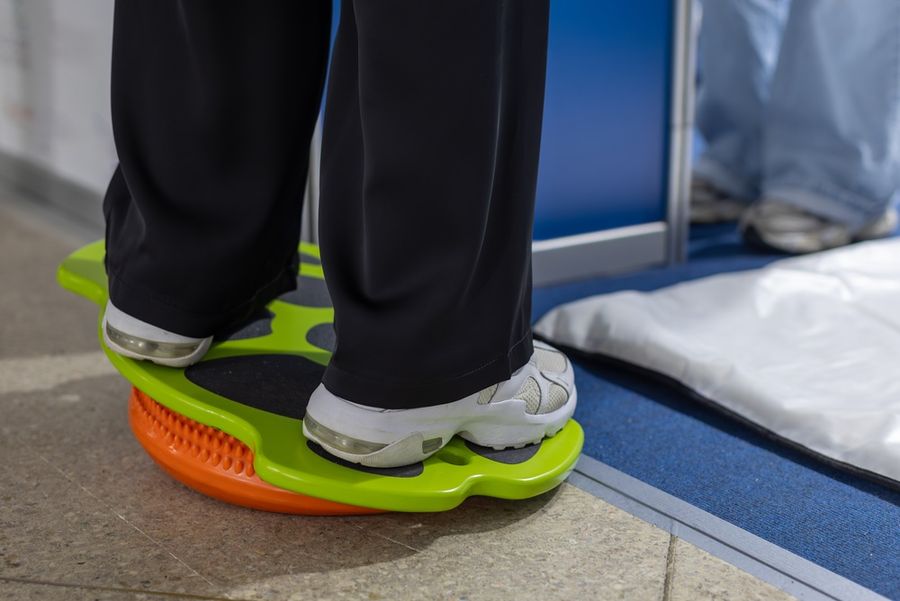
Balance boards bring an instant challenge to an ordinary workout. The moment the platform tilts, the body has to react, adjust, and stay centered. That simple movement can make stability practice feel more active and engaging than standing drills on the floor. Balance boards can support ankle control, coordination, and more active standing, while giving users a clear way to see progress. It's helpful to understand the top balance boards and their potential benefits.
Unstable Surfaces Demand Faster Adjustments
Standing on a balance board is harder than standing on the floor because the surface moves beneath the feet. The ankles, knees, hips, and trunk must keep adjusting to hold the body over the platform. Research describes this as a more complex motor-control task than firm-surface standing.
That challenge is the main reason to use the board. A beginner can start with both feet planted and small side-to-side movements. More advanced users may add shallow squats or reaches. Instability is useful only when the person can still move with control.
Practice Can Improve Board-Specific Balance
A small study of healthy men compared four weeks of wobble-board training with no board training. The trained group roughly tripled the time they could remain balanced on the board. They also used less lower-leg muscle activity and showed slower leg and trunk movements while controlling the unstable surface.
The improvement did not carry over to firm-surface performance in that study. A balance board should therefore not be presented as a tool that improves every form of balance. Its clearest benefit is better control during the type of unstable task being practiced.
Balance Training Can Support Unstable Ankles
Balance boards are often used in ankle rehabilitation because the shifting surface asks the foot and ankle to respond in several directions. A 2024 meta-analysis reviewed 20 studies with 682 participants who had chronic ankle instability. It found that balance training improved self-reported ankle function and measures of dynamic balance.
That evidence applies to people with an established ankle problem, not every healthy user. A previous sprain, repeated “giving way,” swelling, or pain calls for an assessment rather than a self-designed board routine. A physical therapist can decide when unstable-surface work belongs in recovery.
Balance Work Becomes More Important With Age
Balance helps people stay steady while walking, turning, reaching, and moving through daily routines. Balance exercises can help prevent falls and fall-related injuries, and they are an important part of activity plans for older adults.
A board is only one option. Heel-to-toe walking, standing from a chair, and single-leg balance provide simpler starting points. Someone who cannot complete basic floor-based drills safely should not move straight to a tilting platform.
Top Balance Boards to Consider
The Revbalance FIT is a versatile choice for workout use because it comes with three interchangeable bases: a rocker, an air cushion, and a roller. Its grippy top can be used with or without shoes, and the board is rated to support up to 450 pounds. The different bases allow users to begin with a controlled rocking motion before moving to a less stable challenge.
The FluidStance Plane is designed for standing desks and light gym training. It provides movement in every direction, offers cushioned foam or felt top surfaces, and supports up to 300 pounds. The BOSU Home Balance Trainer takes a different approach with an inflatable dome, six rubberized feet, and a 300-pound limit. The Plane is suited to active standing, while the BOSU model provides a larger surface for squats, lunges, and floor-based workouts.
Progress Is Easy to See
A balance board gives immediate feedback. The edge touches the floor, the platform shakes, or the user steps off when control is lost. Progress can be measured through smoother motion, longer holds, fewer touches, or better form.
Keep the challenge narrow enough to track. Practice a two-foot hold before adding a squat, and master slow tilting before attempting single-leg work. Changing several things at once makes progress harder to judge.
Safety Should Come Before Difficulty
Use the board on a level, nonslip surface with a stable counter, rail, or wall nearby. Clear furniture and objects that could cause injury during a step-off. Follow the maker’s guidance for footwear and board placement.
Stop if the exercise causes sharp pain, dizziness, or a feeling that the ankle is giving way. Anyone unsure about a movement, or managing a condition that affects balance, should seek guidance from a doctor or physical therapist.
A Focused Tool for Better Stability
Balance boards make the body practice staying controlled while the surface moves. Research supports better board-specific control, possible gains for chronic ankle instability, and a modest increase in activity during standing desk work.
They work best as one part of a wider routine. Start with basic balance on solid ground, use the board for short sessions, and raise the difficulty only when movement remains smooth. Patience and control create the value.